Why Smart Sanibel Sellers Order the Elevation Certificate Before the Photographer
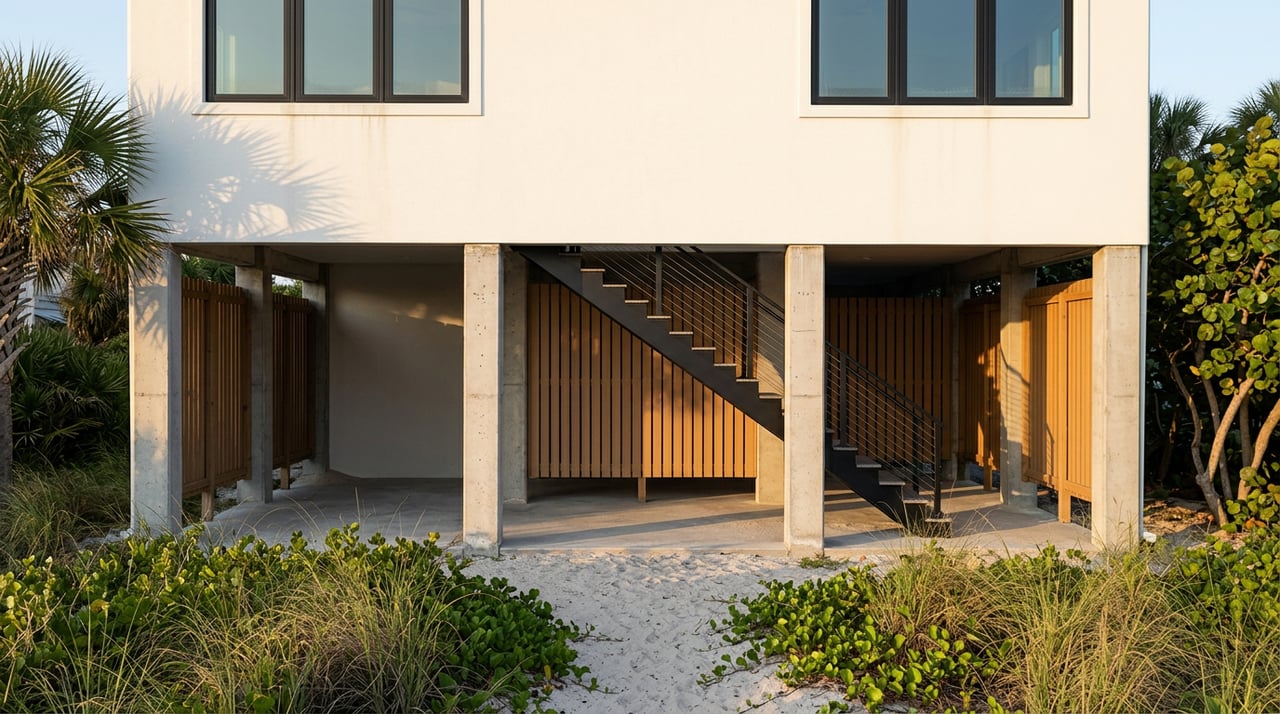
Two houses on the same stretch of Gulf Drive can look nearly identical from the road. Same white stucco, same metal roof, same young landscaping planted where the mangroves got stripped in September 2022. One of them was fully raised to current flood elevation standards after the storm. The other repaired in place at its original, lower elevation. Local buying guides tracking the island's recovery put the annual insurance gap between those two outcomes at $10,000 to $20,000 or more, for otherwise comparable homes. The difference isn't visible from the sidewalk. It's on a form that most sellers don't think to pull until a buyer asks for it, and by then it's already too late to use it the way it was meant to be used.
That form is the Elevation Certificate, and on Sanibel in 2026 it has become one of the more consequential pieces of paper in a real estate transaction. Four years after Hurricane Ian, the island's housing stock is no longer one thing. It's a patchwork of homes that were forced to rebuild to current flood elevation standards and homes that repaired around the edges and stayed exactly where they were before the storm. From the street, you often can't tell which is which. The Elevation Certificate is the document that can.
Under FEMA's Substantial Damage rule, known on the island simply as the 50% Rule, a home with repair costs estimated above half its pre-storm market value has to be brought fully into compliance with current code, flood elevation included. Below that threshold, a homeowner can generally repair in place. That single cost estimate, prepared by a contractor or engineer and reviewed by the city, decided whether a given house on Sanibel ended up on wood or concrete pilings with the living space several feet above its original grade, or stayed close to where it started with a fresh coat of paint and new flooring.
Homes built before 1979, when FEMA first issued flood maps for the island, are the ones most likely to land on the wrong side of that line. The City of Sanibel's Building Division has spent years answering granular questions about exactly where the line falls: whether drywall can go back on wood studs in a ground-level foyer, whether a garage below flood elevation needs fire-rated doors to the living space above it, whether an air handler serving that lower level has to sit above the flood line. Those answers, decided case by case, are why "rebuilt after Ian" can describe two very different structures on the same block. One went through a full teardown and reconstruction on new pilings, meeting the wind design standards in Florida's current building code. The other only replaced finishes. Both are honest uses of the word "rebuilt." Only one of them changes how an insurer prices the policy.
This isn't a historical footnote. This week, on August 31, Benchmark General Contractors is scheduled to break ground on the Gulf Beach Condominium at 527 E. Gulf Drive, a full reconstruction of the 14-unit beachfront community Hurricane Ian destroyed. The new building will rise three floors, two stories of living space over ground-level parking, designed by MK Architecture with engineering by Michael D. Stewart. The project is expected to cost roughly $6.5 million and take about 14 months.
Benchmark, a Fort Myers firm founded in 1984, is running a second Sanibel reconstruction at the same time: the 31-unit Kimball Lodge at 3111 W. Gulf Drive, designed by Christopher J. Lee Architects with engineering by LB Structural Engineering and Jose Castillo as project manager, already under construction and targeted for completion within roughly a year of breaking ground.
Both projects will meet current flood elevation and hurricane wind code requirements as a condition of permitting and financing, not as a marketing choice. That's worth sitting with. Four years after landfall, some of the island's most visible reconstruction is only now getting underway, which means the property-by-property variation buyers keep hearing about isn't settling down. It's still being actively written into the record, one groundbreaking at a time.
An Elevation Certificate records two numbers that matter more than almost anything else in a coastal transaction: the actual elevation of a structure's lowest floor, and the Base Flood Elevation FEMA has set for that spot on the island. A licensed surveyor or engineer produces it. An insurance underwriter uses it to set a flood premium. Without a current one in the file, an insurer is often pricing the policy off a conservative assumption rather than the home's real number, and conservative assumptions tend to be expensive ones.
Here's the part sellers miss. The certificate is the same document whether it shows up in the listing packet on day one or shows up three weeks into a buyer's due diligence period. But its weight in the transaction isn't the same. Handed over early, it reads as proof that the seller already did the homework, and it lets a buyer's insurance agent quote an actual premium before an offer is even written. Requested late, it becomes a contingency, something the buyer's side has to chase down while the clock on a purchase contract keeps running. Same paper, different leverage.
For a seller whose home went through a genuine full-elevation rebuild, ordering the certificate before the first showing turns a compliance requirement into a selling point. For a seller whose home stayed under the 50 percent threshold and was never required to raise the structure, the certificate still matters. It tells a buyer exactly what they're buying, which heads off the harder conversation that happens later when an insurance quote comes back higher than expected.
A clean pre-listing file on Sanibel generally includes:
None of this replaces a conversation with a licensed insurance agent or the engineer who worked on the home. But walking into that conversation with the paperwork already assembled changes how long it takes and how much room there is to negotiate.
Take Sanibel's price data at face value and the market looks like it's accelerating. Median sale prices moved from roughly $880,000 in January 2026 to about $935,000 by February and March, and price per square foot has climbed sharply over the past year. But average days on market told a different story across that same stretch, stretching well past 100 days, with some reporting closer to 150. That's less a contradiction than a description of a market splitting into two speeds at once.
Homes that are fully raised and code-current, the kind coming out of projects like Gulf Beach and Kimball Lodge, are pulling the median up because that's where the premium is concentrating. Homes still carrying older elevation profiles or an unresolved permit history are the ones sitting on the market longer, because buyers and their insurers are pricing in the uncertainty rather than the property itself. A rising median alongside a lengthening time on market isn't a sign of a market simply getting hotter. It's a sign of the market sorting itself by paperwork.
That sorting is exactly why the certificate matters more now than it did before Ian. It used to be a formality nearly every Sanibel home had on file, largely interchangeable from one property to the next. Now it's the fastest way for a buyer, or their insurance carrier, to tell two visually similar homes apart.
Does a home need a new Elevation Certificate after every renovation? Not every renovation, but any project that changes the lowest floor elevation, adds enclosed space below the flood line, or follows a Substantial Damage determination should get a fresh one. A certificate tied to a different version of the structure isn't reliable for pricing today's home.
What if my home was never required to raise its living space? Order the certificate anyway. It documents the home's actual condition and gives a buyer's insurer real numbers to work with instead of a worst-case default.
Who actually checks whether a permit was formally closed? The buyer's agent or the title company typically checks with the City of Sanibel's Building Division before closing. An open permit discovered late in a transaction is one of the more common reasons a Sanibel closing gets delayed.
The paper trail on a rebuilt Sanibel home isn't a formality tacked onto the end of a listing. It's part of the pricing conversation from the first showing. If your home went through the full elevation process, that story is worth telling with documentation, not adjectives. If it didn't, buyers deserve to know that too, and the earlier that's clear, the smoother the rest of the transaction goes.
We've walked island sellers through this exact sequence, from ordering the right survey to reading an insurance quote against a certificate before it's final. If you're weighing when to list a rebuilt or repaired Sanibel property, McMurray & Members is a good place to start that conversation. Let's Talk.

A Local's Guide to the Best Golf Courses in Fort Myers.
Why Mortgage Pre-Approval in Fort Myers Sets Serious Buyers Apart.
Timing Your Sale: The Best Time to Sell a House in Fort Myers.
Debunking the Most Common Home Buying Myths in Fort Myers.
You will appreciate working with a team who is more like an extended family, one that takes care of each other and encourages success. Plus, we are backed by the strength of Royal Shell.