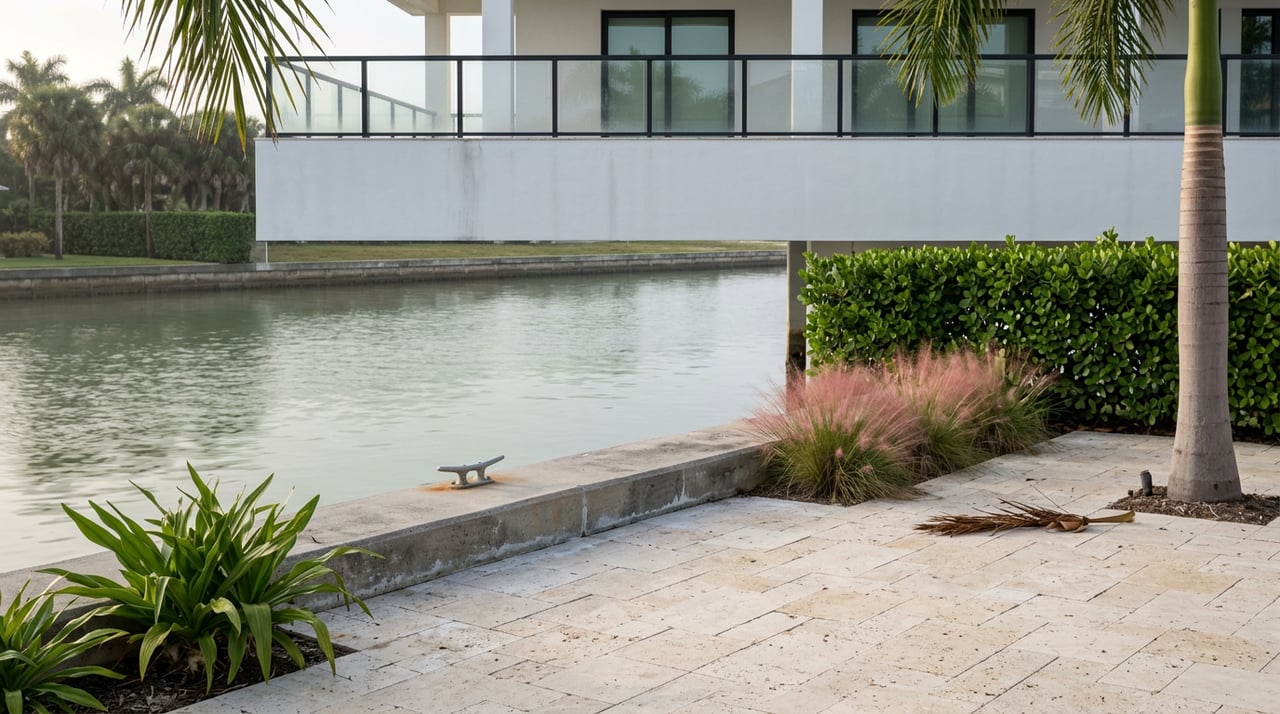
What Cape Coral's Yacht Club Seawall Project Means for Your Canal-Front Listing
Two canal-front homes go under contract in the same week, a few streets apart, priced within a few thousand dollars of each other. One closes on schedule. The other reopens in week two, when the buyer's inspector notes a seawall that has bowed just enough to fail plumb, and the negotiation that follows eats most of the seller's leverage along with two weeks of the calendar. Same city, same canal system, same general condition. The difference wasn't the wall. It was who found out about it first.
That is the quiet mechanic behind every Cape Coral canal-front sale this year, and it is easier to see if you look at what the city itself just did with its own waterfront.
In June 2026, Cape Coral's City Council approved a $105.5 million capital funding package covering parks, transportation, and government facilities. Buried inside that plan is $23 million earmarked for a seawall at the municipal Yacht Club, financed through a $65 million bond authorized under Ordinance 27-26. The council vote split 5-3, with council members Rachel Kaduk, Keith Long, and Jennifer Nelson-Lastra voting against the borrowing, arguing the city had cash on hand that could cover part of the bill instead. The debt service on that project comes out of the general fund, the same account that pays for police, fire, and every other core city service.
None of this happened because the city wanted a nicer stretch of riverfront. Cape Coral has more than 400 miles of residential canals, more than any other city in the world, and the seawalls lining most of them were built decades before anyone was budgeting for a bond issue. A 2019 engineering walk-through of the historic Yacht Club park, conducted with consultant Kimley Horn, concluded the seawalls there had simply reached the end of their functional life. That finding sat inside a master plan for years before the funding mechanism caught up to it.
If the municipality with the largest canal network on earth needed a bond issue to replace one wall, a private homeowner facing the same physics on a smaller scale is not exempt from the math. They just don't get a bond. They get a due-diligence period.
That's the thesis worth sitting with before you list a canal-front home here. The seawall conversation isn't a rare surprise reserved for unlucky sellers. It's baked into the age of the infrastructure itself, and the only real variable left is whether you're the one who raises it.
Cape Coral seawalls are built almost exclusively from two materials now: vinyl sheet pile and precast concrete panel. That wasn't always a choice. For years, city ordinance required concrete only, until Resolution 45-18 passed in February 2018 and opened the door to vinyl alternatives, giving homeowners a materially cheaper option with a longer expected lifespan. The city followed that up with updated engineering design standards, effective March 1, 2022, that apply to any new seawall construction regardless of material, with added requirements for properties on saltwater canals.
Here's roughly what that looks like in dollars on a standard 80 to 100 foot canal lot, the most common frontage in the city:
| Material | Typical cost per linear foot (2026) | Full replacement, 80-100 ft lot |
|---|---|---|
| Vinyl sheet pile | $400 to $650 | roughly $32,000 to $65,000 |
| Concrete panel | $650 to $900 | roughly $52,000 to $90,000 |
| Difficult-access or saltwater sites | Up to $1,200+ | can reach $120,000 |
The spread inside each range usually comes down to three things: whether crews can stage equipment from the yard or need a barge, whether the demo turns up voids or damaged tiebacks behind the old wall, and how much engineering and permitting the site requires. Contractors describe those discoveries as the most common source of change orders on canal properties, which is exactly why a bid that looks unusually cheap is worth a second look before it looks unusually good.
In most Cape Coral canal lots, the property line extends to the center of the canal, which means the homeowner, not the city, owns and is responsible for maintaining the seawall in front of their own property. The city-owned exception is public land, which is why the Yacht Club's frontage is getting a bond-funded repair instead of a private one. For everyone else, the wall is part of the house, the same way a roof or a foundation is, except it sits underwater where nobody walks past it during a showing.
Florida's statutory flood disclosure requirements don't specifically address seawall condition. That gap doesn't mean a seller is free to say nothing. Florida's older common-law rule, the one courts still apply under Johnson v. Davis, requires sellers to disclose known material facts that affect a property's value and aren't obvious to a buyer walking the property. A seawall that's visibly bowed or cracked almost certainly clears that bar. The harder case is the wall that looks fine from the lanai but hasn't been inspected in ten or fifteen years. That's the gray zone plenty of sellers talk themselves into skipping, and it's exactly the zone an inspection resolves before anyone has to argue about what "should have been obvious" means in hindsight.
A marine or seawall inspection in Cape Coral typically runs $500 to $800 and takes under two hours on a standard residential lot. That's a modest fee against a six-figure worst case, and what it buys isn't certainty that nothing is wrong. It buys control over when and how the conversation happens. A typical inspection includes:
The underwater portion matters more than it sounds like it should. A wall can look plumb and clean above the waterline while the toe is already undermined below it, which is the entire reason a diver survey is part of the standard scope and not an upsell.
Put the pieces together and the choice a seller is actually making comes into focus. It was never disclose or don't disclose. It's whether you introduce the seawall's condition on your own terms, backed by a report you commissioned and a repair estimate you already priced, or whether a buyer's inspector introduces the same facts in week two of a fifteen-day due diligence window, at the exact point in a transaction where there's the least room to absorb a surprise.
Agents working this market in 2026 describe a similar pattern on the insurance side. Buyers who don't budget for flood coverage up front tend to hit cost surprises during due diligence that stall or kill deals, while sellers who get ahead of it with a current quote before listing see fewer mid-contract cancellations. The seawall works the same way. The sellers who end up renegotiating from a number they didn't choose are usually the ones who let someone else discover it first.
Who pays for seawall repair, the buyer or the seller? There's no automatic rule. As the owner of record, you're responsible for the wall while you hold the property, but once an inspection surfaces a needed repair, it becomes a negotiated line item in the contract like any other, whether that's a credit, a price adjustment, or a completed repair before closing.
Does the city require a specific material? Not anymore. Concrete panel was the only approved option until Resolution 45-18 opened the door to vinyl in 2018. Both materials now have to meet the city's engineering design standards adopted in 2022, which set requirements around height and construction regardless of which material you choose.
Does flood insurance cover a failed seawall? Flood insurance covers flood damage to the structure and contents of a home, not the seawall itself, and Florida's flood disclosure requirements don't specifically address seawall condition either. That's a separate conversation from your homeowner's or marine coverage, which is one more reason the inspection report matters. It's the document that actually answers the condition question when neither insurance policy will.
If you're weighing a canal-front listing in Cape Coral and want to talk through what a marine inspection looks like for your specific lot, or you're comparing what a wall like this means for pricing before you go to market, McMurray and Members knows this canal system street by street. Let's Talk.


A Local's Guide to the Best Golf Courses in Fort Myers.

Why Mortgage Pre-Approval in Fort Myers Sets Serious Buyers Apart.
Timing Your Sale: The Best Time to Sell a House in Fort Myers.
Debunking the Most Common Home Buying Myths in Fort Myers.
You will appreciate working with a team who is more like an extended family, one that takes care of each other and encourages success. Plus, we are backed by the strength of Royal Shell.